

Both men and women find the shoulder blade area a great canvass for tattoos. This is a good place to put a medium to large tattoo since there is a lot of space. The curve of the shoulder blade lends itself perfectly to shoulder blade tattoos of wings. Because of the little amount of fat on the shoulder area, many people consider shoulder blade tattoos as one of the more painful tattoos to receive. But for most people, the pain of a tattoo is part of the process so it isn't considered much.
Showing posts with label lettering tattoo. Show all posts
Showing posts with label lettering tattoo. Show all posts
Tuesday, June 21, 2011
Shoulder Blade Tattoos - Find the Best For Your Shoulder
Shoulder blade tattoos can be some of the most prominent tattoos you can get. They also have the ability to be easily covered up. You have the best of both worlds. A woman can be very sensual showing her shoulder blade tattoos with a spaghetti strap or strapless top. Since this tattoo can be very prominent, you want to make sure you get a very unique design. I will tell you the best way to do this.

Tuesday, June 7, 2011
Tattoo Artist - How to Choose a Tattoo Artist That Suits You
Choosing a tattoo artist is not as simple as walking into the local tattoo shop and taking the first available chair. Your tattoo is permanent; forever, lifelong. Sure you can have it removed but that is painful and far more costly than the tattoo will be. So be sure. Be really sure. Do not make the decision on a design and artist based on price or timeliness. Anything this important is worth the wait.


First of all, choosing a tattoo artist is closely linked to your choice of design. Your design is very personal, an expression of you, even a statement. Since you will carry this piece of art around with you for the rest of your life, you need to be especially sure that you will always like it. If you are the kind of person who likes to be trendy, consider your choice of design extremely carefully. Stay away from designs based on current fashion. It is likely you will begin to dislike it within a year or so. A good rule of thumb for choosing a tattoo design is to wait a year, then if you still like it, go for it. Plus, the year of waiting is a good time for searching out an artist.
Tattoo Etymology - The History of The Word and The Art of Tattooing
Although tattoos are popular with many social groups in our society but their origins are from very different era. It is believed that tattoo etymology begins in the English language in 1769 with Joseph Banks, the naturalist aboard The Endeavour, explorer Captain James Cook's ship. Whilst sailing throughout Polynesia they took the word tatu from the Tahitian and Samoan languages. In Cook's diary the word is first used as a noun and a verb. Sailors travelling in Polynesia reintroduced the custom into Europe and tattoos were mainly associated with sailors for years (and to some generations still are). Tattooing existed in pre-Christian Germanic and Celtic tribes and was described by Julius Caesar in 54 BC. Today, tattoos are very fashionable for many, but it began in the South Pacific.

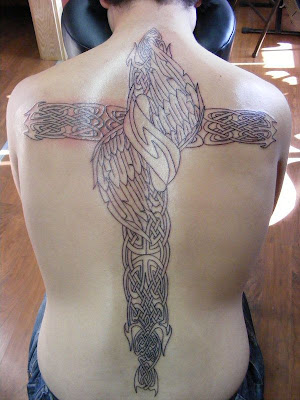
When studied in the future, people will find that tattoo is the second most misspelled word on internet searches and is one of the most commonly misspelled words in the English language. It is often spelled tatu, tato, tatoo and tatto. This is the tattoo etymology given by the Oxford English Dictionary. A variety of spellings of the word tattoo have been used in the arts for example band names and clothing designs.
Monday, May 30, 2011
Japanese Tattoo Lettering - History and Style
In Japan, tattooing and tattoo lettering began primarily as an expression of spirituality. From approximately 300 BC to 300 AD, a Japanese tattoo always conveyed a certain religious meaning for its bearer, and also served as a decorative status symbol.
During this period, tattooing was meticulously practiced and highly regarded. For the tattoo artists, tattooing was not just an occupation, but a way of life. For instance, aspiring apprentices had to train under masters for many years before becoming credible and acknowledged tattoo artists, which are called "horis" in Japan. Only a horis was allowed to create full body suit tattoos.


During this period, tattooing was meticulously practiced and highly regarded. For the tattoo artists, tattooing was not just an occupation, but a way of life. For instance, aspiring apprentices had to train under masters for many years before becoming credible and acknowledged tattoo artists, which are called "horis" in Japan. Only a horis was allowed to create full body suit tattoos.
Subscribe to:
Posts (Atom)